
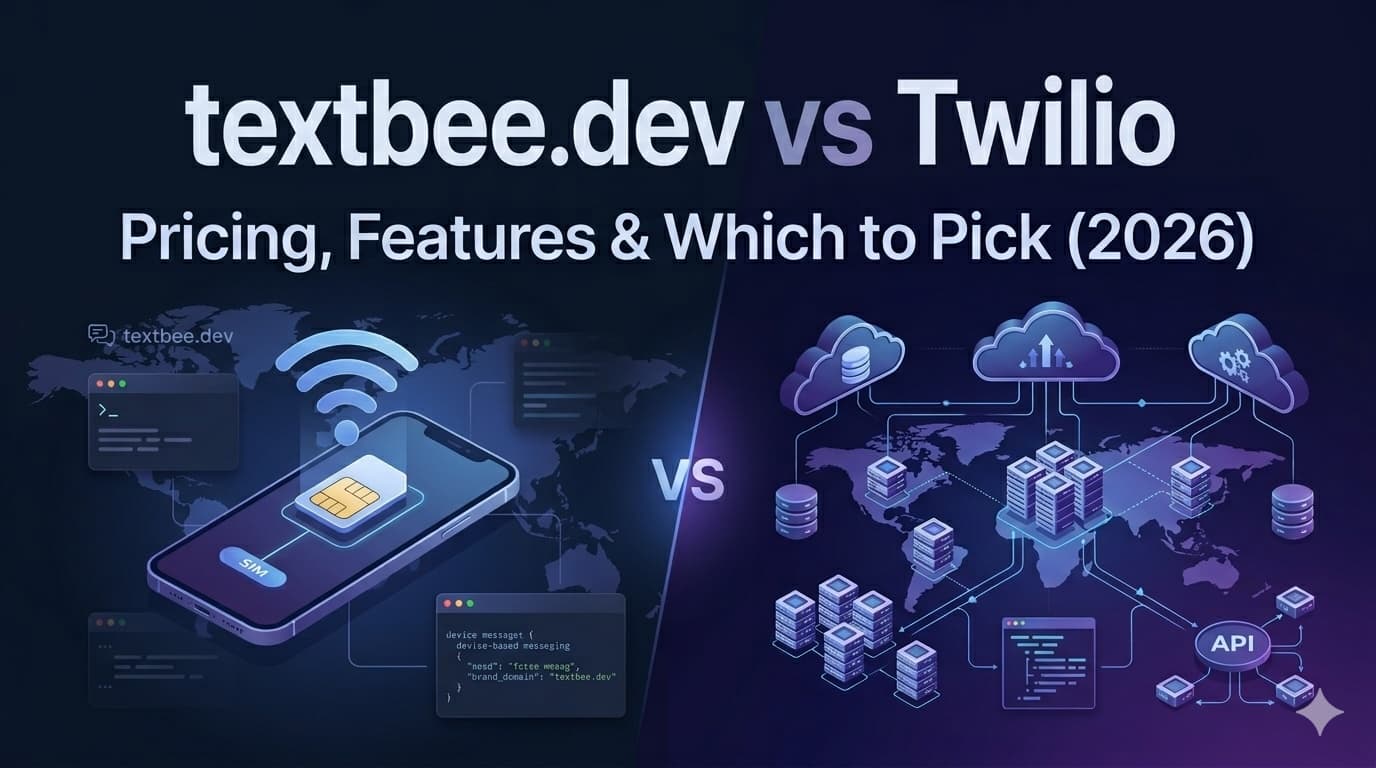
textbee vs Twilio: Full Comparison (2026) - Pricing, Features, Which to Pick
A detailed textbee vs Twilio comparison: real 2026 pricing math, feature breakdown, migration notes, and guidance on which SMS solution fits your use case.
TL;DR
- Twilio is a full cloud communications platform (SMS, voice, video, WhatsApp, email) designed for scale - $0.0083 per US SMS segment plus carrier fees, number rental, and 10DLC registration.
- textbee is an Android SMS gateway - you send SMS through a phone you already own, using its SIM, with a flat monthly subscription and no per-message API fees.
- textbee typically wins for small-to-mid volumes (under ~5,000 messages/month) where cost, a local recognizable number, and simplicity matter most.
- Twilio typically wins for high volumes (100K+/month), global reach, regulated industries needing carrier-grade SLAs, or teams that need voice/video/WhatsApp in the same platform.
- Real-world example: for a salon sending 1,000 appointment reminders per month, Twilio costs approximately $40-$60/month all-in; textbee costs $14.99/month on Pro ($8.33/month billed yearly) plus your existing phone plan.
For the short version with current prices, see the textbee vs Twilio comparison page.
What is textbee?
textbee is an Android-based SMS gateway. You install an Android app on a phone you already own, connect it to your account with an API key, and send SMS through the phone's SIM card via a simple REST API. Recipients see your real phone number.
Category: Self-operated SMS gateway Billing model: Flat monthly subscription Sending method: Your Android phone + SIM
What is Twilio?
Twilio is a cloud communications platform (CPaaS) that provides programmable SMS, voice, video, email (via SendGrid), WhatsApp Business, and more through a unified set of APIs. You rent phone numbers from Twilio and pay per message through carrier-direct interconnects.
Category: Carrier-grade CPaaS Billing model: Pay-as-you-go per message + number rental + 10DLC fees Sending method: Twilio-rented phone numbers over carrier networks
Quick comparison
| Feature | textbee | Twilio |
|---|---|---|
| US SMS outbound | No per-message API fee (uses your SIM) | $0.0083/segment + carrier fees |
| Phone number | Your own SIM | $1.15/month rented |
| A2P 10DLC registration | Not required | Required ($4.50 brand + $1.50-$10/mo per campaign) |
| Setup time | ~5 minutes | 1-3 weeks (incl. 10DLC approval) |
| Sender ID recipients see | Your real local number | Rented Twilio number |
| Voice, video, WhatsApp | No | Yes |
| Global coverage | Wherever your SIM has coverage | 180+ countries |
| Throughput | Limited by SIM/carrier (tens to hundreds/minute) | High (up to unlimited on Standard 10DLC) |
| Pricing model | Flat subscription | Pay-as-you-go |
| Free tier | Limited free messages | Trial credits |
| SLA | Depends on your device and carrier | 99.95% |
| Best for | SMB, <5K msgs/mo, local sending | Enterprise, high volume, global |
Pricing deep-dive: real-world examples
Example 1: Salon sending 1,000 appointment reminders/month (US)
Twilio (long code, A2P 10DLC registered, standard campaign):
| Line item | Monthly cost |
|---|---|
| 1,000 segments × $0.0083 | $8.30 |
| Carrier fees (avg $0.004/msg) | $4.00 |
| Phone number rental | $1.15 |
| 10DLC campaign fee (standard) | $10.00 |
| 10DLC brand fee (amortized) | ~$0.40 |
| Total (approx.) | ~$24/month |
Plus one-time setup: $4.50 brand + $15 campaign vetting = $19.50.
textbee:
| Line item | Monthly cost |
|---|---|
| Flat textbee subscription | $14.99 on Pro, or $8.33 billed yearly (see pricing) |
| Carrier SMS (likely included in existing plan) | $0 incremental |
| Phone number | $0 (your own) |
| Total (approx.) | $14.99/month, or $8.33 on yearly billing |
Example 2: SaaS sending 50,000 OTPs/month (US)
At 50,000 messages/month, Twilio's carrier-grade throughput and automatic volume discounts start to matter. Twilio all-in is approximately:
| Line item | Monthly cost |
|---|---|
| 50,000 × $0.0083 | $415 |
| Carrier fees (~$0.004/msg avg) | $200 |
| Phone number + 10DLC | ~$12 |
| Total | ~$627/month |
textbee at this volume is not the right fit - consumer SIMs and Android throughput aren't built for 50K/month of time-sensitive OTP traffic. For this use case, Plivo ($0.005) or Telnyx ($0.004) typically win on cost, while Vonage Verify wins on OTP-specific features.
Example 3: Dental clinic sending 300 reminders/month
At this volume, textbee's flat subscription is effectively a fraction of a cent per message, while Twilio's 10DLC campaign fee alone ($10/month) exceeds the actual messaging cost. textbee is the obvious winner.
Feature-by-feature comparison
Setup and time-to-first-message
- textbee: Install the Android app, paste API key, send. ~5 minutes.
- Twilio: Sign up, verify identity, buy a number, register your brand, create a 10DLC campaign, wait for approval (1-3 weeks typical), then send.
Winner for speed: textbee.
Sender identity (what the recipient sees)
- textbee: Your real mobile number - the same one on your business card.
- Twilio: A Twilio-provisioned long code (unfamiliar 10-digit number), toll-free number, or short code.
Why this matters: Research on SMS open and reply rates consistently shows that messages from recognizable local numbers have higher trust and reply rates than unknown long codes.
Winner for trust signal: textbee.
Throughput and reliability
- textbee: Throughput is limited by your Android device and carrier SIM. Typical practical throughput: tens to a few hundred messages per minute per device. You can scale horizontally by connecting multiple devices/SIMs.
- Twilio: Carrier-grade throughput. Long codes allow 1-10 messages per second depending on Trust Score; short codes allow 100+/second.
Winner for high-volume sending: Twilio.
Compliance and regulation
- textbee: Uses a consumer/business SIM. 10DLC registration typically not required for transactional personal-volume use. You're still responsible for TCPA consent and opt-out handling.
- Twilio: Enforces and requires A2P 10DLC registration for US long codes. Offers Compliance Toolkit and Verify for regulated OTP flows.
Winner for regulated enterprise: Twilio. Winner for simple transactional SMB: textbee.
Developer experience
- textbee: One REST endpoint, JSON body, API key auth. Minimal SDK surface.
- Twilio: Comprehensive SDKs in 8+ languages, extensive docs, Messaging Services, Studio visual flow builder, Verify, Conversations.
Winner for simple use cases: textbee. Winner for complex/multi-channel: Twilio.
Multi-channel (voice, video, WhatsApp, email)
- textbee: SMS only (by design).
- Twilio: SMS, MMS, Voice, Video, WhatsApp Business, email (via SendGrid), RCS.
Winner: Twilio.
Support and SLA
- textbee: Community support plus direct team support on paid plans. SLA depends on your own device uptime and carrier.
- Twilio: 99.95% SLA, paid support tiers from $250/month, global 24/7 on enterprise.
Winner for mission-critical enterprise: Twilio.
When to choose textbee
Choose textbee if most of these apply:
- You send under ~5,000 SMS/month.
- You want customers to see your real, local phone number.
- You want predictable flat-rate costs - no per-segment surprises.
- You want to avoid A2P 10DLC registration.
- Your use case is transactional: appointment reminders, order updates, OTP for internal tools, delivery notifications, booking confirmations.
- You're a salon, clinic, dentist, veterinary practice, home-services business, small SaaS, agency, or indie developer.
- You want to set up in minutes, not weeks.
When to choose Twilio
Choose Twilio if most of these apply:
- You send 50,000+ SMS/month with bursty traffic patterns.
- You need global reach across 180+ countries.
- You need voice, video, WhatsApp, or email in the same platform.
- You require carrier-grade SLAs and enterprise support.
- You operate in a highly regulated industry (finance, healthcare with PHI at scale) where carrier-direct compliance matters.
- Your engineering team is already fluent in Twilio and the cost is acceptable.
- You need Twilio Verify for OTP with fraud detection at scale.
Can you use textbee and Twilio together?
Yes. A common pattern:
- textbee for customer-facing transactional SMS from your local number (reminders, confirmations, replies).
- Twilio for high-volume system messages (OTP at scale, international reach, WhatsApp).
This gives you the trust advantage of a local number for human-facing messages and carrier-grade reach for infrastructure-level messaging.
How to migrate from Twilio to textbee
- Identify which message flows actually need Twilio's scale or channels - keep those on Twilio.
- Identify SMB-volume transactional flows (reminders, confirmations, simple notifications) - these are textbee candidates.
- Install the textbee Android app on a dedicated phone.
- Generate your textbee API key and swap the HTTP endpoint in your code.
- Normalize phone numbers to E.164 (they probably already are, if you were using Twilio).
- Test delivery on a small batch for a week.
- Cut over the chosen flows and monitor.
Full code example in our Python integration guide and Node.js guide.
Frequently asked questions
Is textbee cheaper than Twilio?
For small-to-mid volume SMS sending (about 1,000 to 5,000 messages/month), yes - textbee's flat subscription typically costs about 35-80% less, or 65-89% less on yearly billing, than Twilio's all-in per-message + carrier fee + number rental + 10DLC cost. At high volumes (100K+/month), Twilio or another carrier-grade API (Plivo, Telnyx) usually wins on per-message economics.
Can textbee replace Twilio completely?
For use cases limited to transactional SMS from a local number at small-to-mid volume, yes. For use cases requiring voice, video, WhatsApp, global reach, or carrier-grade throughput, no - Twilio or another CPaaS is the right tool.
Do I need A2P 10DLC registration with textbee?
Typically not, because textbee sends through a consumer/business SIM rather than a carrier-direct A2P interconnect. You are still responsible for TCPA-compliant consent and opt-out handling. Verify specifics with your carrier's terms of service.
Is textbee reliable enough for appointment reminders?
Yes, with the right setup. Use a dedicated Android device on stable Wi-Fi and power, enable auto-start permissions, and implement retry logic with delivery webhooks. For critical notifications, keep an email fallback. Most small businesses achieve delivery rates comparable to carrier APIs for domestic messaging.
What happens if my Android phone goes offline?
textbee's webhook system surfaces device status, and messages can be queued and retried on reconnect. For mission-critical flows, run two devices in parallel or keep a fallback provider. See textbee's reliability docs for details.
Can I use textbee for OTP / 2FA?
Yes for internal tools, small SaaS apps, and personal projects. See our 2FA setup guide. For high-volume consumer OTP with fraud detection, Twilio Verify or Vonage Verify are purpose-built alternatives.
Can I send international SMS with textbee?
Yes, as long as your SIM and carrier plan support international SMS. Costs depend entirely on your carrier's international SMS rates. Twilio offers more predictable global pricing but at higher per-message rates.
Does textbee support MMS?
textbee focuses on SMS. If you need MMS (images, rich media), Twilio, Plivo, or Bird are better fits in 2026.
Start sending with textbee
Get more textbee in Google Search
Add textbee.dev as a preferred source. Our posts show up more often in your Google results.
You may also like
9 Best Twilio Alternatives in 2026 (Cheaper SMS APIs Compared)
Compared: Plivo, Telnyx, Vonage, Bird, Sinch, Bandwidth, AWS SNS, ClickSend, and textbee. Real 2026 pricing, pros, and cons for each alternative.
Twilio SMS Pricing 2026: The Real Monthly Cost (With Hidden Fees)
Twilio's $0.0083/segment headline price hides carrier fees, number rental, and 10DLC registration costs. Here's what you actually pay at 500, 2,000, and 10,000 messages/month in 2026.
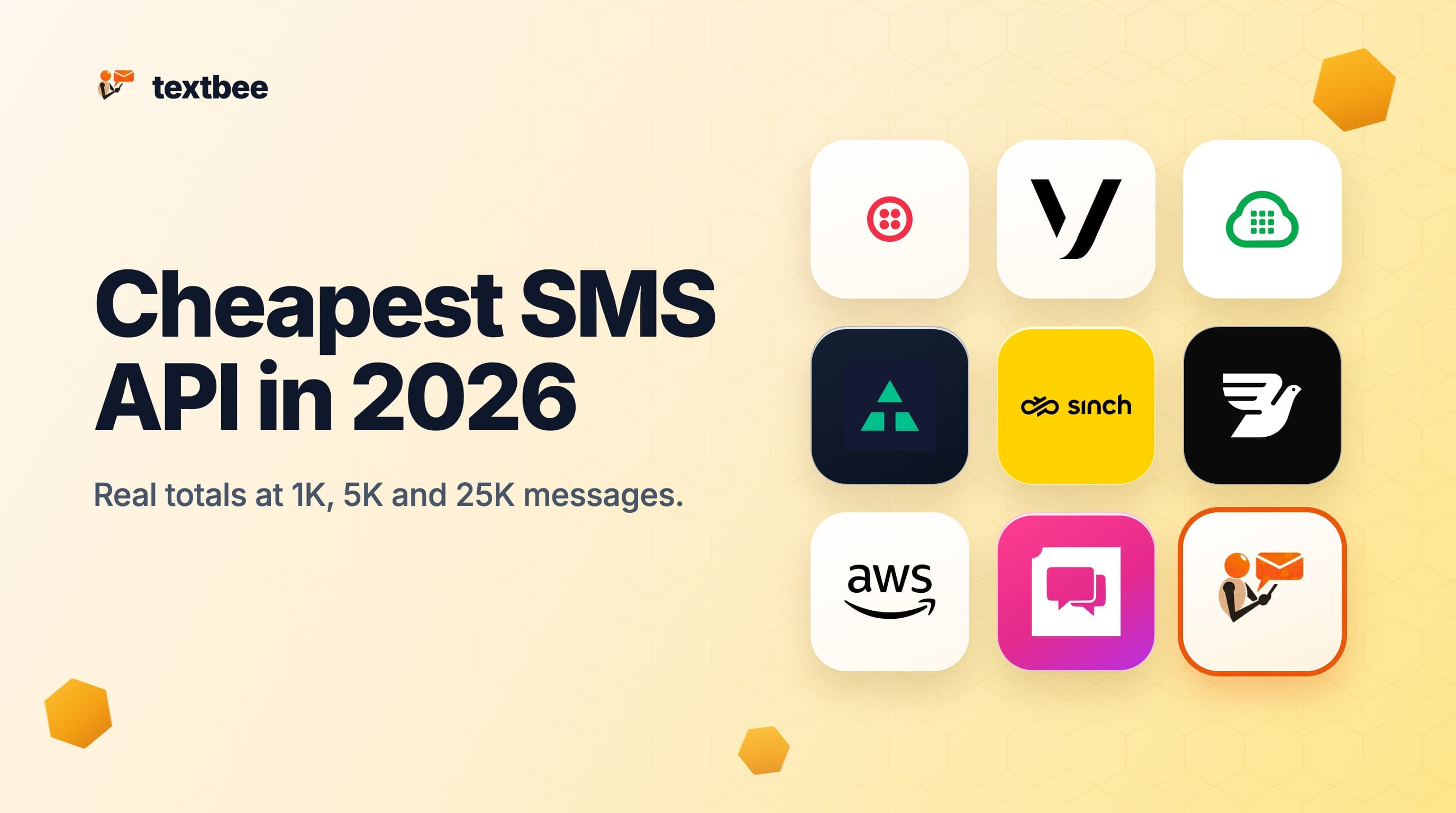
Cheapest SMS API and Gateway Options in 2026 (Real Monthly Totals)
The cheapest SMS API and SMS gateway options in 2026, priced honestly: per-message rate plus carrier fees plus number rental, totalled at 1,000, 5,000 and 25,000 messages a month for Telnyx, Bird, Plivo, Twilio, Vonage, Sinch, AWS, ClickSend and textbee.