
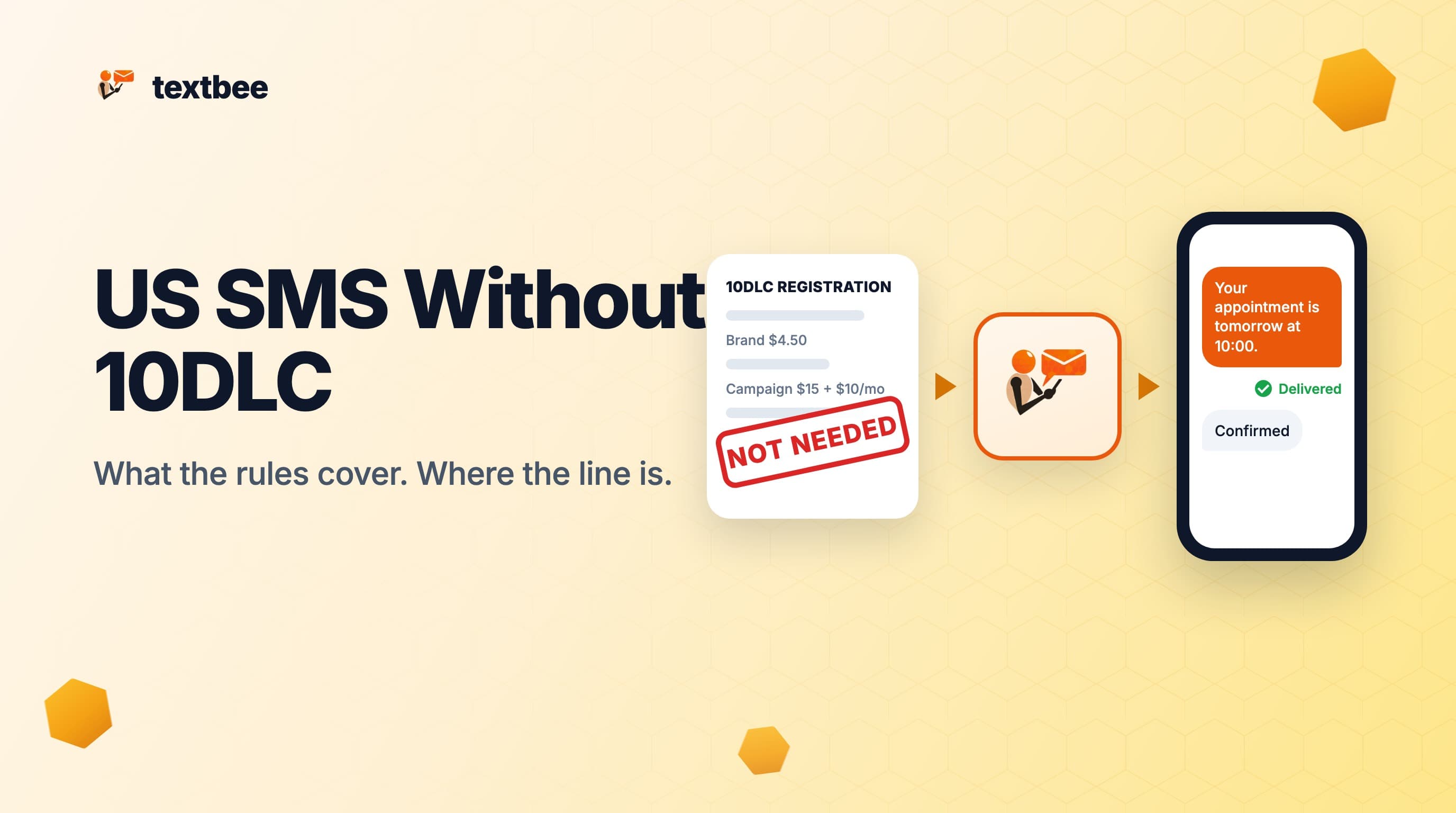
Send SMS in the US Without 10DLC Registration: What the Rules Cover and Where the Line Is
What 10DLC registration is, what Twilio and Plivo charge for it (brand, vetting, monthly campaign and per-message carrier fees), who it applies to, and when a US business can send transactional SMS from its own phone number without registering anything.
TL;DR
- 10DLC is the registration system US mobile carriers run for application-to-person (A2P) SMS sent over ordinary ten-digit numbers that a messaging platform provisions. If you rent a number from Twilio, Plivo, Vonage or any cloud provider and send business texts from it, you register a brand and a campaign or your messages get filtered.
- It costs money and time. On Twilio a brand is $4 (low volume or sole proprietor) or $44 (standard, vetting included), each campaign is $15 to vet and $1.50 to $10 a month, and every message carries a carrier fee of $0.0035 to $0.005 on top of the $0.0083 rate (checked September 23, 2026). Plivo's rates are in the same range. Add days to weeks of waiting.
- 10DLC applies to numbers a platform provisions for A2P traffic. It does not apply to the SIM in a phone, because a carrier issued that line to you directly. A phone-based gateway sends from that SIM, so there is no brand, campaign or number to register.
- That removes the registration, not the rules. Consent under the TCPA (47 CFR 64.1200), honoring STOP, and your carrier's fair-use terms still apply, and carriers filter spam-like patterns on consumer lines. Transactional texts to your own customers from your own number are what a phone gateway is for. Marketing blasts at volume belong on a registered 10DLC route.
What 10DLC is
A long code is a regular ten-digit US phone number. For years businesses sent automated texts from long codes with no registration, carriers could not tell a clinic's reminders from a spammer's blast, and they filtered both unpredictably.
10DLC replaced that. Plivo's overview puts it in one sentence: "10DLC (10-digit long code) is a service offered by US mobile network operators to explicitly allow application-to-person (A2P) SMS traffic over long code phone numbers." The carriers, through The Campaign Registry, verify two things before traffic is allowed:
- A brand: the business that wants to text its customers, identified by its legal name, EIN and address.
- A campaign: the use case (account notifications, marketing, 2FA and so on) with sample messages.
Brands do not register directly. They go through a campaign service provider, which is almost always the cloud SMS platform they buy numbers from. Once approved, the brand's traffic gets carrier throughput tied to a trust score. Unregistered A2P traffic on the same carriers is throttled or blocked.
What 10DLC costs
The fees are set by the registry and the carriers and passed through by every platform. Plivo publishes its table on its 10DLC overview (prices from August 1, 2025, checked September 22, 2026):
| Fee | Frequency | Price |
|---|---|---|
| Brand registration | One time | $4.50 |
| Brand vetting (optional, raises throughput) | One time | $41.50 |
| Brand appeal | One time | $11 |
| Campaign vetting | One time | $15 |
| Campaign fee | Monthly | $10, or $1.50 for low volume (billed quarterly) |
Twilio's fees are itemized in the next section. So the smallest possible registered setup is about $20 up front and $18 to $120 a year on top of the number rental (about $1 a month) and the per-message rate plus carrier fees. On top of the money, a standard brand registration takes days and a campaign review can take weeks, and a rejected campaign starts over.
For a business sending 5,000 texts a month that is a rounding error. For a solo developer, a clinic or a shop sending 200 reminders a month it is more than the messages cost.
Twilio 10DLC pricing
Twilio passes the registry and carrier fees through and adds its own per-message and number prices. These are the amounts on Twilio's 10DLC page and US SMS pricing page, checked September 23, 2026.
Registration fees
| Registration type | Brand registration (one time) | Campaign vetting (one time, per campaign) | Campaign fee (monthly, per campaign) |
|---|---|---|---|
| Sole proprietor (no EIN, one number, low volume) | $4 | $15 | $2 |
| Low-volume standard | $4 | $15 | $1.50 to $10 by use case |
| Standard (vetting included, higher throughput) | $44 | $15 | $1.50 to $10 by use case |
The $44 standard brand is the $4 registration plus secondary vetting, which is what raises the daily message cap. A rejected campaign is vetted again on resubmission, so a first attempt that fails costs the $15 twice. Twilio's pricing breakdown covers the rest of the bill.
Per-message fees
| Item | Price |
|---|---|
| Outbound SMS, US long code | $0.0083 per segment |
| Carrier fee, AT&T | $0.0035 per segment |
| Carrier fee, T-Mobile | $0.0045 per segment |
| Carrier fee, Verizon | $0.0045 per segment |
| Carrier fee, US Cellular | $0.005 per segment |
| Carrier fee, other US carriers | $0.004 per segment |
| Long code rental | $1.15 per month |
So a registered US text on Twilio costs $0.0118 to $0.0133 depending on the recipient's carrier, before the fixed fees. A 200-character message is two segments and pays every per-segment fee twice.
What that adds up to
Using $0.0045 as the carrier fee, one long code and one $10 standard campaign:
| Messages a month | Messages plus carrier fees | Number and campaign | Twilio total a month | textbee plan |
|---|---|---|---|---|
| 200 | $2.56 | $11.15 | $13.71 | Free, up to 300 included |
| 500 | $6.40 | $11.15 | $17.55 | $14.99, up to 5,000 included |
| 2,000 | $25.60 | $11.15 | $36.75 | $14.99, up to 5,000 included |
| 5,000 | $64.00 | $11.15 | $75.15 | $14.99, up to 5,000 included |
| 25,000 | $320.00 | $11.15 | $331.15 | $29.99, up to 25,000 included |
Plus $19 up front for a low-volume brand and one campaign, or $59 for a standard brand. The textbee column is the platform fee; the messages come out of the SIM's plan, which on an unlimited-text plan adds nothing per message. A $1.50 low-volume campaign instead of the $10 one takes $8.50 off every Twilio row.
Who 10DLC applies to
The scope is in the definition: A2P traffic over long codes that messaging platforms provision. Three things have to be true for 10DLC to apply to you:
- You send from a ten-digit US number, not a toll-free number (those have their own verification) or a short code (its own approval process).
- The number was provisioned by a messaging platform connected to the carriers' A2P interconnect.
- The traffic is application-to-person: sent by software on behalf of a business.
A phone with a SIM fails the second test. The carrier issued that line to you as a wireless subscriber, and it sends over the same path as a person typing a text. There is no campaign service provider in the chain, so there is nothing to register with The Campaign Registry and no fee to pay. That is why a phone-based SMS gateway has no 10DLC step: it is not an exemption, it is a different path.
What still applies when you send from your own phone
The registration goes away. Three sets of rules do not.
The TCPA. 47 CFR 64.1200 requires prior express consent before an automated text is sent, and prior express written consent when the text advertises. A recipient may revoke consent in any reasonable manner and you must honor it within ten business days. This applies to every business text in the US regardless of how it is sent. The TCPA and opt-in checklist lists the records to keep.
The CTIA principles. The carriers' Messaging Principles and Best Practices classify traffic by who sends it, not by which path it takes. A business, organization or entity is a Non-Consumer sender and is expected to hold consent, hold written consent for marketing and let recipients opt out. Automation used by a business is not typical consumer operation in the carriers' eyes.
Your carrier's fair-use terms. A consumer or small-business wireless plan is sold for a person's texting. Carriers watch for patterns that do not look like a person: hundreds of identical messages in minutes, high volumes to numbers that never reply, links in every message. They filter or suspend lines that trip those patterns. This is the practical limit of a phone gateway, and it is the same limit that applied before 10DLC existed.
Where the line is
Put the three rules together and the line is clear enough to act on.
| Traffic | From your own phone, no 10DLC | Registered 10DLC route |
|---|---|---|
| Appointment reminders, order updates, delivery alerts to your customers | Yes. Transactional, consented, low volume, from a number they can call back | Works, but you pay registration for traffic that did not need it |
| Login codes and verification for your app | Yes, up to the phone's throughput (10 to 15 a minute) | Yes, and required above a few thousand an hour |
| Alerts from your own systems to your own team | Yes | Overkill |
| Replies and two-way conversations | Yes, that is what a real number is for | Yes |
| Marketing to an opted-in list of a few hundred | Yes, paced, with STOP handling and written consent on file | Yes |
| Marketing blasts to thousands, cold outreach, lead-gen texting | No. Carriers will filter the line and the TCPA exposure is the same either way | This is what 10DLC exists for |
| Anything above about 1,000 messages a day | Only with several phones on paid plans; a carrier route is the honest answer | Yes |
If your traffic is in the top five rows, registering a brand and a campaign buys you nothing you need. If it is in the bottom two, register.
When Twilio gets too expensive
Twilio's price is not high. Its shape is wrong for small transactional senders, because the fixed part of the bill does not shrink with volume. Four signs that the shape is costing you:
- The fixed fees are most of the bill. At 500 messages a month, $11.15 of the $17.55 is number rental and the campaign fee. Below about 900 messages a month you pay more to hold the number and the campaign than to send.
- You registered for traffic that never needed it. Appointment reminders, order updates and login codes to your own customers from a number they can call back do not need a brand or a campaign. The registration fee, the wait and the resubmission cycle bought nothing.
- The bill tracks your signups. At $0.0128 a message, 5,000 messages is $75 and 25,000 is $331 a month, against $14.99 and $29.99 flat. A product that sends one OTP per login pays Twilio more every month it grows.
- A campaign got rejected, or throttled. A low-volume brand without secondary vetting gets a low daily cap on T-Mobile. Raising it costs $40 and a second review, for traffic a phone sends without either.
What to move and what to keep:
| Move to your own number | Keep on Twilio |
|---|---|
| Reminders, order and delivery updates, receipts | Marketing blasts to thousands of numbers |
| Login codes and verification up to a phone's throughput (10 to 15 a minute) | Verification above a few thousand codes an hour, or with SIM swap and fraud signals |
| Two-way conversations with customers | Short codes and toll-free at volume |
| Alerts to your own team | Traffic to many countries, where a cloud route picks local carriers |
Moving is small work. Install the textbee app on an Android phone with a US SIM, create an API key, and change the send call to POST /gateway/send-sms with an x-api-key header. The Twilio comparison has the request side by side, and the twilio alternatives roundup covers the cloud providers if you want to keep a registered route for marketing. Keep the Twilio number for a month with a forwarding message if customers still text it, then release it and stop the rental and campaign fees.
What sending from your own phone looks like
textbee is an Android app plus a REST API. Install the app on a phone with a US SIM, link it to your account, create an API key, and send:
curl -X POST https://api.textbee.dev/api/v1/gateway/send-sms \
  -H "x-api-key: $TEXTBEE_API_KEY" \
  -H "Content-Type: application/json" \
  -d '{"recipients": ["+12025550123"], "message": "Main Street Clinic: your appointment is tomorrow at 10:00. Reply C to confirm or STOP to opt out."}'
The text leaves from the SIM's number. Replies come back to it and reach your code through a webhook or GET /gateway/messages. There is no number to rent, no brand form and no campaign review. The platform side costs $0 for up to 300 messages a month, $14.99 for up to 5,000 and $29.99 for up to 25,000, and the messages cost whatever your phone plan charges for a text, which on an unlimited plan is nothing. The US SMS gateway page has the SIM plans and carrier notes.
Three setup habits keep a consumer line healthy:
- Pace sends. The app sends one message at a time with a short pause; do not fight that with a second sender on the same SIM.
- Name your business in the first message and include STOP handling. Recipients who know who is texting do not report the number.
- Keep the phone on a business plan if you can. Prepaid consumer plans have the tightest fair-use terms.
Frequently asked questions
Is it legal to send business SMS without 10DLC registration?
10DLC is a carrier industry program, not a law. It applies to A2P traffic on numbers that messaging platforms provision. Sending from a SIM the carrier issued to you is outside that program. The law that applies to every business text is the TCPA, and it applies whether or not you register.
Will my SIM get blocked for sending business texts?
Carriers block patterns, not categories. A few hundred consented, varied, transactional texts a day from a line that also receives replies looks like a business using its phone. Thousands of identical messages in an hour with links looks like spam and gets filtered. The fair-use terms of your plan are the rule to read.
How much does 10DLC cost per month?
On Twilio, $1.50 to $10 a month per campaign by use case ($2 for a sole proprietor), plus $4 once for a low-volume brand or $44 for a standard brand with vetting, and $15 once per campaign vetting (checked September 23, 2026). Plivo publishes $10 a month per standard campaign, $1.50 for low volume, $4.50 for the brand and $15 per campaign vetting (August 2025 rates). Number rental and per-message carrier fees are separate on both.
How much does Twilio 10DLC pricing add to a message?
Per message, the carrier fee: $0.0035 on AT&T, $0.0045 on T-Mobile and Verizon, $0.005 on US Cellular and $0.004 elsewhere, on top of Twilio's $0.0083. Per month, $1.15 for the number and $1.50 to $10 for the campaign. At 500 messages a month the fixed part is about two thirds of the bill.
When is Twilio too expensive for SMS?
When the number and campaign fees are most of what you pay, which is below about 900 messages a month, or when the bill grows with every signup because each message costs about $0.0128. Transactional texts to your own customers at up to a few thousand a month cost less from your own phone on a flat plan. Marketing at volume and multi-country traffic still belong on a registered cloud route.
Does 10DLC apply to toll-free or short codes?
No. Toll-free numbers have their own verification process and short codes have their own approval. 10DLC is only for ten-digit long codes provisioned for A2P traffic.
When should I register anyway?
When you send marketing at volume, when you need more than one phone's throughput for time-critical traffic, when a customer or auditor requires a registered sender identity, or when you send from a rented number. A cloud provider's registered route is the right tool for that traffic, and the best SMS APIs comparison lists the options with current prices.
Next steps
- SMS gateway for the United States: SIM plans, carrier notes and the cost against Twilio
- TCPA and opt-in checklist: the consent records to keep
- Twilio pricing, the real cost: 10DLC and carrier fees itemized
Get more textbee in Google Search
Add textbee.dev as a preferred source. Our posts show up more often in your Google results.
You may also like

SMS Compliance Checklist: TCPA, Opt-In, and Best Practices (2026 Update)
A practical SMS compliance checklist for US marketers and developers. TCPA, consent, opt-out, and how to send compliant SMS campaigns.
Twilio SMS Pricing 2026: The Real Monthly Cost (With Hidden Fees)
Twilio US SMS pricing, checked October 2026: $0.0083 a segment plus $0.0035 to $0.005 carrier fees, number and 10DLC costs, and real monthly totals.

What Is an Android SMS Gateway? How It Works, Pros, Cons & When to Use One (2026)
An Android SMS gateway turns a phone you already own into a programmable SMS sender. Learn how it works, when it beats Twilio, real costs, and setup steps.