
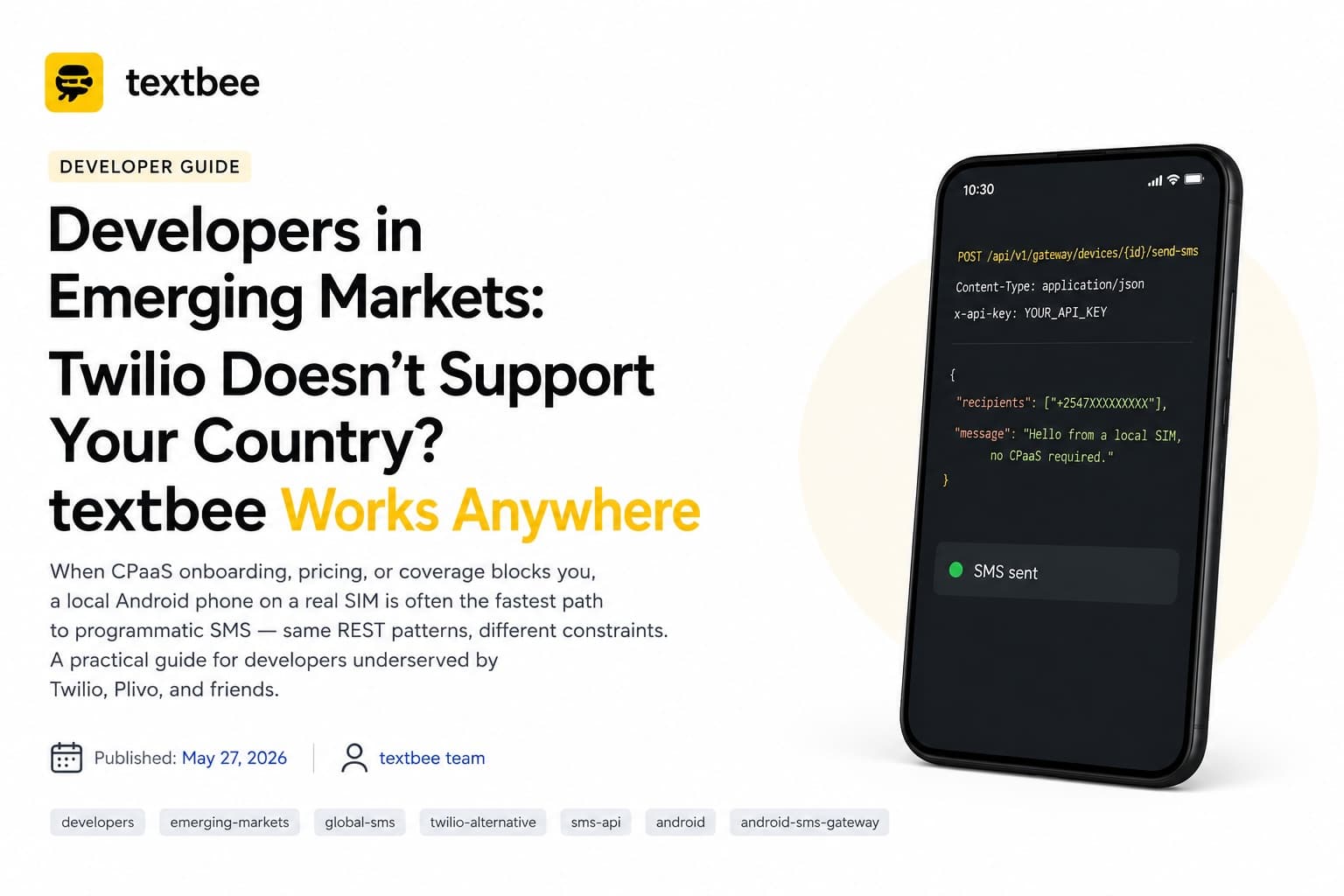
Developers in Emerging Markets: Twilio Doesn't Support Your Country? textbee Works Anywhere Android Works
When CPaaS onboarding, pricing, or coverage blocks you, an Android phone on a SIM is often the fastest path to SMS for developers underserved by Twilio.
TL;DR
- This post is for developers in emerging markets, and anyone CPaaS underserves, who need programmatic SMS but keep hitting "country not supported", impossible verification flows, or US/EU-priced segments.
- textbee is not magic cloud routing. It is SMS through a physical Android phone on whatever SIM and carrier terms you can legally use locally, exposed via a REST API and webhooks.
- Same backend ergonomics as Twilio (HTTP, API keys, webhooks), with no signup gatekeeper, no 10DLC, and no US-only billing.
- Download the Android app and you can be sending API-driven SMS in about five minutes.
Global SMS APIs are amazing when your country, entity type, and use case are on the happy path. When they are not, you hit walls that have nothing to do with your skills: verification queues, unsupported sender types, pricing that assumes US/EU volumes, or product availability that simply does not list where you build from.
This post is for developers in emerging markets (and anyone CPaaS underserves) who still need programmatic SMS and are tired of being told "not yet" by a dashboard.
The honest constraint
textbee is not magic international routing in the cloud. It is SMS through a physical Android on whatever SIM and carrier terms you can legally use locally.
That means:
- If Android + your carrier can send SMS to the numbers you care about, your backend can send them too, via HTTP API and webhooks.
- If a destination is blocked by your carrier policy, no vendor stack fixes that without a different route (often a different product category entirely).
The value is access and control: you stop waiting on a San Francisco signup flow to bless your geography and start shipping with hardware you can buy today. If you're comparing tools at this layer, the Twilio alternatives roundup covers the global CPaaS landscape and where each one actually operates.
Same developer ergonomics
You still integrate like a modern backend:
- REST API for outbound messages.
- Webhooks for inbound SMS and delivery context (subject to device and app configuration).
- API keys and device IDs, familiar primitives if you have ever integrated Stripe, Twilio, or Firebase.
The patterns map cleanly to anything you've built before, see the textbee use cases guide for OTP, reminders, alerts, and inbound-reply flows.
If you want the philosophical contrast to CPaaS, read textbee vs Twilio: same "programmable messages" story, different transport assumptions.
Compliance stays yours
Emerging-market speed does not mean ignoring rules. You still need:
- Clear user consent and purpose limitation for marketing vs transactional messages.
- Respect for local telecom regulations and carrier acceptable-use policies.
- Sensible rate limits so automation does not burn the SIM or trigger anti-fraud blocks.
textbee removes the vendor gatekeeper problem; it does not remove your responsibility to send like a professional.
Money and uptime reality
- Cost follows your local prepaid/postpaid reality, not USD list prices per segment. A typical regional unlimited-SMS plan turns the marginal per-message cost to effectively zero. textbee's own flat subscription pricing sits on top of that.
- Uptime follows your power, network, and device health. For mission-critical, multi-region traffic, CPaaS still exists for a reason.
Pick textbee when the bottleneck is "I cannot even get started with the APIs everyone blogs about." Graduate later if your scale demands it.
Try it
- Register at textbee.dev.
- Install from download on an Android phone with a working local SIM.
- Complete the quickstart and send your first API-driven SMS.
Minimal code example
Once your device is connected and you have a device ID + API key, sending an SMS from anywhere on the planet looks like this:
curl -X POST "https://api.textbee.dev/api/v1/gateway/send-sms" \
  -H "x-api-key: YOUR_API_KEY" \
  -H "Content-Type: application/json" \
  -d '{
    "recipients": ["+2547XXXXXXXX"],
    "message": "Hello from a local SIM, no CPaaS required."
  }'
Same shape in your language of choice:
Frequently asked questions
Will textbee work in my country?
If Android works in your country and your SIM can send SMS to the numbers you care about, yes. textbee does not depend on any per-country onboarding or carrier interconnect agreement, the only requirement is a phone with cellular service. That covers essentially every country with a mobile network.
Do I need a special SIM or carrier plan?
No. A standard consumer or business SIM is enough. For predictable cost, a plan with unlimited or generous SMS allotments is ideal. For high deliverability on bulk sends, avoid prepaid plans that aggressively throttle automated traffic.
How do I handle local opt-out and consent rules?
The same way you would on any platform: capture explicit opt-in, label transactional vs marketing traffic, and honor STOP / UNSUBSCRIBE replies. textbee's inbound webhook makes the opt-out flow easy to implement, see the receive-SMS section of the quickstart.
What happens if my local carrier throttles automated SMS?
Carriers in many markets apply soft rate limits or anti-spam scoring on SIMs that send unusually high volumes. Mitigations:
- Send below ~1 message/second sustained on a single SIM.
- Avoid identical message bodies sent to large lists in a short window.
- Rotate or add SIMs if you outgrow a single device.
- Keep your traffic transactional and consented.
Can I scale to multiple devices later?
Yes. textbee supports multiple Android devices on one account, so you can horizontally scale throughput, separate sender numbers per business unit, or add geographic redundancy by deploying devices on different SIMs.
Is textbee a Twilio replacement for international SMS?
For your own region, often yes. For global multi-country bursts on a single integration, no; that is still CPaaS territory. A common pattern is to run textbee locally and keep a CPaaS account for the destinations you can't cover from your SIM.
Ship from where you actually are
If Android works where you are, your stack can too, without waiting for a checkbox in someone else's country list.
- Download textbee: install on any Android 7+ phone with a working SIM.
- See pricing: flat subscription, free tier to test.
- Browse the API docs: send, receive, webhooks.
- Start with the 5-minute quickstart.
Questions or stuck? Email support@textbee.dev.
Get more textbee in Google Search
Add textbee.dev as a preferred source. Our posts show up more often in your Google results.
You may also like
Open Source SMS Gateway: Self-Host Your Own with an Android Phone (2026)
textbee is an MIT-licensed, self-hostable SMS gateway. What open source means here, self-hosted vs managed, how to run it with Docker Compose, and how it compares with Gammu and other Android gateways.
Migrate from Twilio to an Android SMS Gateway: Step by Step (2026)
How to migrate SMS from Twilio to an Android phone running textbee: map every Twilio concept to its replacement, swap the send call, rewrite the status and inbound webhooks, run both side by side, then cut over. Node.js and Python code, before and after.

What Is an Android SMS Gateway? How It Works, Pros, Cons & When to Use One (2026)
An Android SMS gateway turns a phone you already own into a programmable SMS sender. Learn how it works, when it beats Twilio, real costs, and setup steps.